Puff Balls

Puff Balls
Showing posts with label Black America. Show all posts

Monday, July 11, 2011

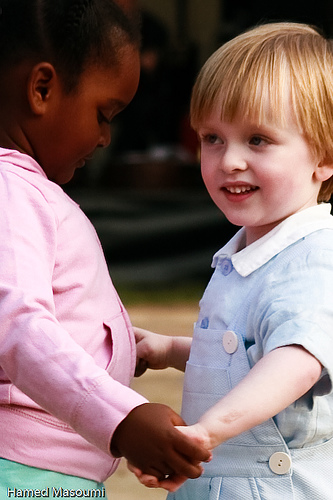
Beach bonding and interracial friendship


My daughter and I had an AMAZING time at the beach: white sand, clear water, sand dunes. Wow, we had an absolute ball. All was going well. My daughter even met a few friends to play with at the beach. One of them, a little girl (can’t remember her name) was thrilled that my daughter is a cartwheel enthusiast and the two of them somersaulted down the beach. Under my watchful eye, they also cavorted in the water and were having a fabulous time. Until. Until.


The two girls were stomach down lying next to my beach blanket. My ears perked up when I heard the little girl whisper, “Are you black?” My daughter looked at her and said something like, “No, I’m brown. Does that look black to you?” holding up her arm for review. The other little girl looked baffled. Her tone of voice had sounded like she’d come upon some great secret, this brown little girl next to her was an alien! But wait, if she’s not black, is she really an alien? Her face looked dejected.


Some of you may wonder why we train our children to say that they’re brown. Of course, we are also very proud and knowledgeable of our Black heritage, exposing our children to history and current events as much as we can. However, we want our children to know: 1) that race is a social construct and 2) there are BILLIONS of brown people around the world and we are part of that Diaspora. I believe that people’s conception of race start in scenarios just like this one. I was grateful that my daughter understood that her skin does not define who she is. But wait, the day held one more surprise as the little girl turned to my daughter and made one more comment, this time about her hair.


P.S.: Here’s an interesting article I came across on interracial friendships by Nadra Kareem Nittle (8/7/10) on news.change.org: http://news.change.org/stories/what-are-the-barriers-to-interracial-friendships.


Curious to know what you think about our beach experience and the article.

Beach bonding and interracial friendship


My daughter and I had an AMAZING time at the beach: white sand, clear water, sand dunes. Wow, we had an absolute ball. All was going well. My daughter even met a few friends to play with at the beach. One of them, a little girl (can’t remember her name) was thrilled that my daughter is a cartwheel enthusiast and the two of them somersaulted down the beach. Under my watchful eye, they also cavorted in the water and were having a fabulous time. Until. Until.


The two girls were stomach down lying next to my beach blanket. My ears perked up when I heard the little girl whisper, “Are you black?” My daughter looked at her and said something like, “No, I’m brown. Does that look black to you?” holding up her arm for review. The other little girl looked baffled. Her tone of voice had sounded like she’d come upon some great secret, this brown little girl next to her was an alien! But wait, if she’s not black, is she really an alien? Her face looked dejected.


Some of you may wonder why we train our children to say that they’re brown. Of course, we are also very proud and knowledgeable of our Black heritage, exposing our children to history and current events as much as we can. However, we want our children to know: 1) that race is a social construct and 2) there are BILLIONS of brown people around the world and we are part of that Diaspora. I believe that people’s conception of race start in scenarios just like this one. I was grateful that my daughter understood that her skin does not define who she is. But wait, the day held one more surprise as the little girl turned to my daughter and made one more comment, this time about her hair.


P.S.: Here’s an interesting article I came across on interracial friendships by Nadra Kareem Nittle (8/7/10) on news.change.org: http://news.change.org/stories/what-are-the-barriers-to-interracial-friendships.


Curious to know what you think about our beach experience and the article.

Monday, May 23, 2011

White privilege and Black middle class norms by Stephanie Diane

Guest blogger Stephanie Diane

Today I have a special treat for you all! One of my goals with this blog is to develop a forum where women with different life experiences can discuss what hair means to them. Today, we have a guest writer who goes by Stephanie Diane when she writes online. Stephanie is as an African-American academic who lives, loves and travels in Europe. She calls the Washington, DC area home, but lived in the mid-Atlantic region, Northeast, Rockies and West Coast before moving abroad seven years ago. When choosing her next destination, the question "Where will I get my hair done?" is always at the top of the list. Stephanie wrote about her experience having natural hair:


Wearing tightly curled natural hair not only challenges European beauty norms, but it also violates middle class social norms among Black Americans. Historically, the middle class Black American formula for success has been academic and professional achievement plus light skin (or a light skinned spouse) and straight hair.

In a world where you can buy straight hair in a relaxer box or a bag of weave, my hair is a multi-vocal political statement. When it comes to my hair, I am tiptoeing around white privilege and class privilege. My education and job mean that I can be deviant without too many economic or social consequences. But I can also get away with a textured hairstyle in my highly skilled profession because my skin is light enough that I could pass for biracial, Latina or Middle Eastern.

In my late teens, I started figuring out what straightening my hair meant in racial and class terms. And because I ticked all the other good-bourgie-girl boxes (good grades, social grace and cross-cultural fluency), I wasn’t going to sacrifice my scalp to the cause too.

Wearing my afro says to everyone else, “No, really, I’m Black.” To the home team, it says “Thanks for the equal education and job opportunities. Now back off with the Jack and Jill. I got this.”


I’d love to hear your thoughts on Stephanie’s post. What do you think hair says about White privilege and Black middle class norms? Happy Monday!

White privilege and Black middle class norms by Stephanie Diane

Guest blogger Stephanie Diane

Today I have a special treat for you all! One of my goals with this blog is to develop a forum where women with different life experiences can discuss what hair means to them. Today, we have a guest writer who goes by Stephanie Diane when she writes online. Stephanie is as an African-American academic who lives, loves and travels in Europe. She calls the Washington, DC area home, but lived in the mid-Atlantic region, Northeast, Rockies and West Coast before moving abroad seven years ago. When choosing her next destination, the question "Where will I get my hair done?" is always at the top of the list. Stephanie wrote about her experience having natural hair:


Wearing tightly curled natural hair not only challenges European beauty norms, but it also violates middle class social norms among Black Americans. Historically, the middle class Black American formula for success has been academic and professional achievement plus light skin (or a light skinned spouse) and straight hair.

In a world where you can buy straight hair in a relaxer box or a bag of weave, my hair is a multi-vocal political statement. When it comes to my hair, I am tiptoeing around white privilege and class privilege. My education and job mean that I can be deviant without too many economic or social consequences. But I can also get away with a textured hairstyle in my highly skilled profession because my skin is light enough that I could pass for biracial, Latina or Middle Eastern.

In my late teens, I started figuring out what straightening my hair meant in racial and class terms. And because I ticked all the other good-bourgie-girl boxes (good grades, social grace and cross-cultural fluency), I wasn’t going to sacrifice my scalp to the cause too.

Wearing my afro says to everyone else, “No, really, I’m Black.” To the home team, it says “Thanks for the equal education and job opportunities. Now back off with the Jack and Jill. I got this.”


I’d love to hear your thoughts on Stephanie’s post. What do you think hair says about White privilege and Black middle class norms? Happy Monday!

Sunday, April 10, 2011

Natural Hair Care Process (at least what my Momma used to do!)

Growing up, I felt that my tightly coiled, cottony hair was a curse. So, I had a love / hate relationship with the Saturday morning ritual of getting my hair washed, conditioned, combed out, plaited into four big sections, blow-dryed, greased and pressed with a sizzling hot comb. Someone shared with me that with the rising rate of biracial families and children, there is an increasing need for folks to learn how to care for Black hair like mine. So, in this post, I’m going to go step-by-step through the process my mom used to wash and style my hair.

First came the washing. Waaaay back in the day, it was just my Mom, me standing on a kitchen chair with a towel around my neck, the kitchen faucet and me (later, we graduated to a sprayer and that made things much easier). I’d bend over and the warm water would go from the nape of my neck to the front of my head (and face!). My Mom was a great sudser and I have great memories of the thorough scrubbing she’d give my scalp and hair. Wash, rinse, wash, rinse, wash. Towel blot, then condition.

I’d sit with the conditioner on my hair, sometimes with a heat cap (or a plastic cap you can get at the beauty store) on. Then, my Mom would rinse one more time and then, ugh, came the combing. It hurt like a mug. There’s no other way to put it. My once long pressed hair had now shrunk to one to two inches of tightly curled, thick hair. A funny story about how water shrinks my hair. When I was about four or five years old, my family lived in the Philippines (my Dad was in the Navy). We had a housekeeper named Vergie and one day she took the initiative to wash my hair. BIG mistake. When my Mom got home, Vergie was in tears and, through her sobs, she promised my Mom that she’d only washed my hair, she hadn’t done anything to make my hair fall out. My Mom had to let Vergie know that nothing was wrong, in fact, that’s what my hair naturally does. It shrinks when water touches it.

After the combing I’d usually have an attitude, but my Mom wasn’t having that. Back then, children with attitudes were dealt with, not tolerated. Anyway, I digress. I was tender-headed so it really was an arduous process but I wanted my hair to look “nice” so I sat and dealt with it. After combing through my hair, it was parted into four sections and each section was plaited. My Mom did this so that my hair would stay untangled, plus plaiting is a way to prevent additional hair shrinkage.

Next, my Mom would loosen one plait at a time and take small sections to blow dry. She’d start at the root and work her way to the ends. She’d then clip the newly blow-dried hair to one side and repeat the process for the rest of my hair. Then, she’d oil my scalp (note: we used to use petroleum-based products but now I use oils that blend in when applied to my skin and I avoid petroleum products. An Internet search for petroleum products and black hair will provide much insightful information about this topic).

While greasing my scalp, my Mom would have put the straightening comb on the stove to heat. Oh my goodness. The memories, the memories. By the time my scalp was oiled, the hot comb would be smoking hot. So hot, that she’d take a folded paper towel and lightly touch it to the comb. If the paper towel turned brown, the comb was too hot and would burn my hair. She’d blow on the comb until it reached the right temperature. Then, sizzzlllllllllllleeeeee, she’d comb my hair with the hot utensil one or two times, then, back on the stove it went. The process was pretty simple, EXCEPT when she used the hot comb near my ears and on the edges. Oh my gosh!!! I just said that my Mom greased my scalp. Well, what happens when grease gets hot? It catches on FIRE!!! No, my hair didn’t catch on fire but it sure felt like my ears and forehead got burnt up (I had the burn scabs to prove it). Once the straightening was done, my Mom might braid my hair, put it into a ponytail or some other nice style. Whew, done for the week.
Saturday, April 9, 2011

Towel Head

One of my earliest hair memories is how upset I was as a little girl that my hair didn’t move like Charlie’s Angels when I stuck my head out the car window as we travelled along. The wind would make my eyes tear up but every follicle stayed in place. I tried again and again, no movement. God, this is a rip-off! I was so disappointed and angry that I’d been cursed with cottony, disobedient hair. My hair is thick and coarse. Hmm, those aren’t the only words we used to describe my hair. Here are a few: kinky, nappy, tight, rough, bad, difficult, brittle, peasy, linty, puffy, unmanageable, and hard. Not very positive attributes but that is just how it was.

The funny thing is that I grew up in a loving household. My parents made sure that we grew up feeling good about our blackness. Our house was filled with Black History trivia games; long discussions about Roots (we watched it as a family); awe-filled conversations about George Washington Carver, Mary McLeod Bethune, Sojourner Truth, Shirley Chisholm, Ida Barnett, and Barbara Jordan to name a few. Plus, my parents always told us that we were beautiful, intelligent women who would grow up to do something big in the world.

Yet, despite this enriching environment, I still remember my sister and I walking around the house with our long beautiful “towel” hair, the result of wrapping bath towels around our heads so that we could pretend that we had long hair. Perhaps because of my parents, we not only pretended to be Charlie’s Angels (I always emulated Kelly, I thought she was the smartest and the prettiest) but I typically played Jayne Kennedy (former Ms. Ohio USA and actress, now a wife, mother and children’s activist) and my sister was Jody Watley (of Shalamar fame). We would daydream about our beautiful homes, gorgeous husbands and fabulous lifestyles, all while making sure that our towel hair was neatly tucked into our shirt collars or else…well, in our minds our nappy hair didn’t go with the fantasy. Some might argue that this is just a little girl fantasy. However, in hindsight, it seems like much more than that. We were trying to escape, escape the reality that we somehow had hair that was less than what society told us was beautiful. So what did we do? We did what any creative child would do. We reinvented ourselves in the dominant image of beauty and that meant long, wavy straight hair no matter how it came about.

Fast forward thirty years and I look at my beautiful daughter and son. Here we are living in a majority white area and I am so concerned that my children realize how beautiful they are: ALL of who they are their soft, cottony hair, strong minds, beautiful brown skin and all.

I have a few questions for you: What adjectives do you recall being used to describe your hair? What do you do with your children to instill a sense of worth in environments where they are often bombarded with statements / images to the contrary?

Friday, April 8, 2011

Loc Wearer on Hunt for Salon in Boston

Whatever your beliefs about the cohesion (or lack thereof) of “Black” America* , one thing that binds us together is our hair. That’s right, our hair. I’ve talked with lots of Black men and women about this topic and no matter where folks are from, how old they are, how much money they earn, whether they have a weave, a natural hairstyle, a relaxed do, bald head or fade, we are all in search of the perfect hair salon or barbershop. If we’re blessed enough to find a place we like (love), we are worried that the stylist is going to leave and then we’ll be back on that search again.

I had to recently go on the hunt for a good stylist. I have locs that are to the middle of my back and people who know me often say, “Girl, you have a LOT of hair”. I do. I can do it myself but it takes about 5-7 hours. Therefore, I NEED a good stylist. The search was prompted because my family and I recently moved to the suburbs of Boston, MA from New York. In New York, a wonderful loctitian came to my house to do my hair. She was a talented loctitian who nurtured my hair and crafted it into beautiful, woven updos. I miss her!

When we moved to the Boston area, I was concerned with normal moving issues, like would our children adjust to their new schools, would my husband and I excel at our new jobs, would we like our house and neighbors, you know, the typical stuff. In addition to these concerns, I scanned my neighborhood and thought, “Where in the world am I going to get my hair done?” I mean, a visit to the local drug store revealed that the shelves had NO ethnic hair care products. No gel, no sheen, no oil, no grease, no shampoo that wouldn’t completely dry out my hair, nothing. I guess this is because our area is basically a lily-white town. According to Wikipedia, based on a 2007 Census Bureau estimate there are 85% Whites, 10% Asian, and the remaining 5% is comprised of Blacks (2.2%), while Hispanics or Latinos of any race were 3.4% of the population.

When I moved here, I had no idea of the journey that was ahead of me. The real journey began when I got that first relaxer as a little girl.

*I just finished reading Eugene Robinson's book, "Disintegration: The Splintering of Black America". It is a great read and should start some wonderful conversations.